Chemistry Notes
Chapter 8.
CHEMICAL REACTIONS
Addresses part of Massachusetts Curriculum Frameworks, content standard 5
Evidence of a chemical reaction
Writing chemical reactions
(
s
) = solid
(
l
) = liquid
(
g
) = gas
(
aq
) = aqueous solution
Balancing chemical reactions
H
2
O
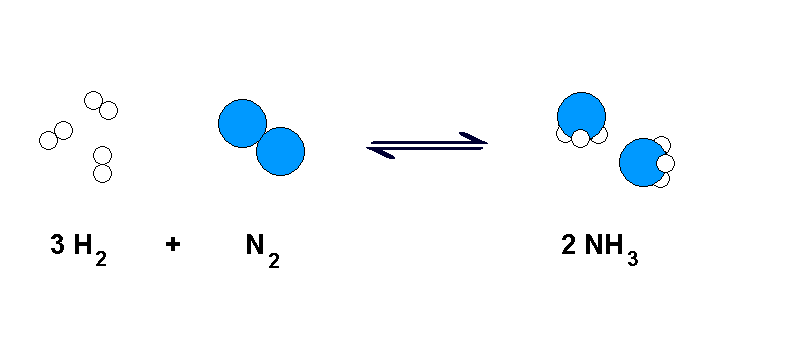
NH
3
Make sure all formulas are correct!
You may not change them!
Remember 7 elements that form diatomic molecules:
H
2
, N
2
, O
2
, F
2
, Cl
2
, Br
2
, I
2
Uncombined elements should be balanced
LAST
Keep polyatomic ions together as much as possible
If OH
-
occurs, rewrite water as HOH
Proceed by trial and error, one thing at a time
When finished,
check everything
over again
Types of chemical reactions
Synthesis (usually includes oxidation/reduction)
Decomposition (usually includes oxidation/reduction)
Combustion of a compound = decomposition + synthesis (
always
includes oxidation/reduction)
Single replacement (
always
includes oxidation/reduction)
Double replacement (double displacement, metathesis)
Predicting oxidation-reduction reactions;
activity series
L
oss of
E
lectrons is
O
xidation - -
L. E. O.
G
ain of
E
lectrons is
R
eduction - -
G. E. R.
Remember:
LEO
says
"GER"
LEO
Types of double replacement reactions:
Reversible equilibria
Reactions that form water (acid/base neutralizations, etc.)
Precipitation reactions
Solubility rules
Reactions that produce gases
Chapter Index
Honors Chem Syllabus
Prev
rev. Dec. 2010
Next